pysdic.get_quadrangle_4_gauss_points#
- get_quadrangle_4_gauss_points(return_weights=False)[source]#
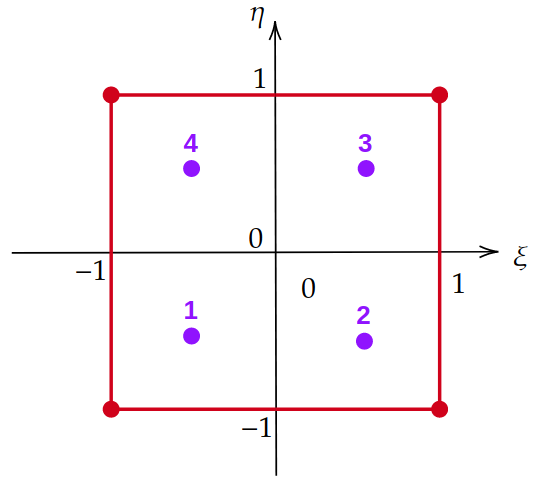
Get the natural coordinates \((\xi, \eta)\) and weights of Gauss quadrature points for a 4-node quadrangle element.
- Parameters:
return_weights (
bool, optional) – IfTrue, the function will also return the weights associated with each Gauss point. Default isFalse.- Returns:
gauss_points (
numpy.ndarray) – Natural coordinates of the Gauss points. The returned array has shape (4, 2).weights (
numpy.ndarray, optional) – Ifreturn_weightsisTrue, the function also returns an array of weights with shape (4,) associated with each Gauss point.
- Return type:
Notes
A 4-node quadrangle element uses the following Gauss points and weights for numerical integration:
Point No.
\((\xi, \eta)\)
Weight \(w\)
1
\((-\frac{1}{\sqrt{3}}, -\frac{1}{\sqrt{3}})\)
\(1\)
2
\((\frac{1}{\sqrt{3}}, -\frac{1}{\sqrt{3}})\)
\(1\)
3
\((\frac{1}{\sqrt{3}}, \frac{1}{\sqrt{3}})\)
\(1\)
4
\((-\frac{1}{\sqrt{3}}, \frac{1}{\sqrt{3}})\)
\(1\)
See also
pysdic.compute_quadrangle_4_shape_functionsShape functions for 4-node quadrangle 2D-elements.
Examples
Get the Gauss points for a 4-node quadrangle element:
1import numpy
2from pysdic import get_quadrangle_4_gauss_points
3
4gauss_points = get_quadrangle_4_gauss_points()
5print("Gauss points:")
6print(gauss_points)
Gauss points:
[[-0.57735027 -0.57735027]
 [ 0.57735027 -0.57735027]
 [ 0.57735027  0.57735027]
 [-0.57735027  0.57735027]]