pysdic.Camera.visualize_projected_mesh#
- Camera.visualize_projected_mesh(mesh, vertices_color='black', vertices_size=5, vertices_opacity=1.0, edges_color='black', edges_width=1, edges_opacity=1.0, faces_color='red', faces_opacity=0.5, image=None, clip_sensor=True, show_pixel_grid=False, show_vertices=True, show_edges=True, show_faces=True, title=None)[source]#
Visualize the projected 2D mesh of a
Meshon a 2D plot using matplotlib.See also
project_points()to project 3D points to 2D image points.visualize_projected_point_cloud()to visualize projected 3D point clouds.pysdic.Meshfor the structure of the input.Package matplotlib for visualization.
- Parameters:
mesh (
Mesh) – The 3D mesh to visualize.vertices_color (
str, optional) – The color of the mesh vertices (default is"black").vertices_size (
int, optional) – The size of the mesh vertices (default is5).vertices_opacity (
float, optional) – The opacity of the mesh vertices (default is1.0).edges_color (
str, optional) – The color of the mesh edges (default is"black").edges_width (
int, optional) – The width of the mesh edges (default is1).edges_opacity (
float, optional) – The opacity of the mesh edges (default is1.0).faces_color (
str, optional) – The color of the mesh faces (default is"red").faces_opacity (
float, optional) – The opacity of the mesh faces (default is0.5).image (Optional[Union[
numpy.ndarray,Image]], optional) – An image to display as the background (default is None).clip_sensor (
bool, optional) – Whether to clip points outside the sensor dimensions (default isTrue).show_pixel_grid (
bool, optional) – Whether to show the pixel grid on the image (default isFalse).show_vertices (
bool, optional) – Whether to show the mesh vertices (default isTrue).show_edges (
bool, optional) – Whether to show the mesh edges (default isTrue).show_faces (
bool, optional) – Whether to show the mesh faces (default isTrue).title (Optional[
str], optional) – An optional title for the plot. Default is None with default title ‘Projected Mesh on Image Plane’.
- Return type:
None
Examples
Visualize a projected
Meshusing a simple camera:import numpy from pysdic import Camera from pycvcam import Cv2Extrinsic, Cv2Intrinsic from pysdic import Mesh rotation_vector = numpy.array([0.1, 0.2, 0.3]) translation_vector = numpy.array([12.0, 34.0, 56.0]) extrinsic = Cv2Extrinsic.from_rt(rotation_vector, translation_vector) intrinsic = Cv2Intrinsic.from_matrix( numpy.array([[1000, 0, 320], [0, 1000, 240], [0, 0, 1]]) ) camera = Camera( sensor_height=480, sensor_width=640, intrinsic=intrinsic, extrinsic=extrinsic, ) # Define a simple triangle mesh vertices = numpy.array([ [0, 0, 1000], [100, 0, 1000], [50, 100, 1000], [0, 100, 1000] ]) connectivity = numpy.array([ [0, 1, 2], [0, 2, 3] ]) mesh = Mesh(vertices=vertices, connectivity=connectivity) # Visualize the projected mesh camera.visualize_projected_mesh(mesh=mesh, faces_color="blue", edges_color="black", vertices_color="red")
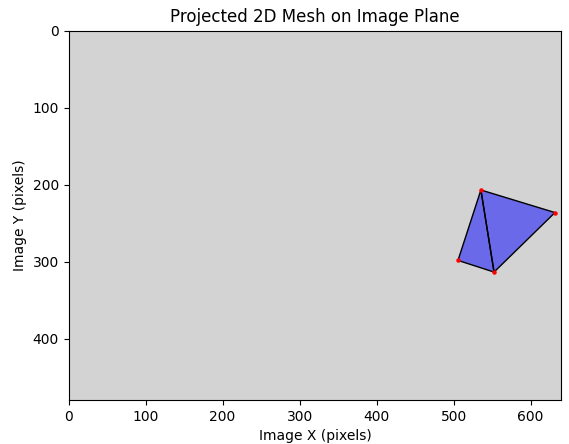
Example of projected mesh visualization. This figure shows the 2D projection of the 3D mesh onto the image plane.#