pysdic.fem.remap_integration_points_neighborhood#
- remap_integration_points_neighborhood(elements_neighborhood, element_indices, *, skip_m1=True)[source]#
Remap a neighborhood of the elements of a mesh to the integration points: for each element, get the integration points located in the elements of its neighborhood.
Note
Input
element_indiceswill be converted tonumpy.int64.
Important
With
skip_m1=True, the points with element index-1(outside the mesh) belong to no neighborhood. Withskip_m1=False, negative element indices raise anIndexError.- Parameters:
elements_neighborhood (Union[ArrayLike, scipy.sparse.spmatrix]) – The neighborhood of the elements as a square matrix of shape \((N_{e}, N_{e})\) (sparse or dense), where a non-zero entry at \((i, j)\) means that element \(j\) is in the neighborhood of element \(i\) (see
pysdic.fem.compute_elements_neighborhood()).element_indices (ArrayLike) – An array of shape \((N_{p},)\) containing the indices of the element of each of the \(N_{p}\) integration points.
skip_m1 (bool, optional (default:
True)) – If set to True, the points with element index-1are ignored.
- Returns:
points_neighborhood – A boolean sparse matrix of shape \((N_{e}, N_{p})\), where the integration points in the neighborhood of element \(i\) are
points_neighborhood[i].indices(sorted).- Return type:
Notes
Let \(\mathcal{V} \in \{0, 1\}^{N_{e} \times N_{e}}\) be the elements neighborhood and \(C \in \{0, 1\}^{N_{e} \times N_{p}}\) the matrix such that \(C_{e,p} = 1\) if point \(p\) is located in element \(e\). The points neighborhood is the boolean product \(\mathcal{V} C\).
See also
pysdic.fem.compute_elements_neighborhoodNeighborhood of each element of a mesh.
pysdic.fem.compute_integration_points_neighborhoodNeighborhood of integration points directly from the mesh connectivity.
Examples
Create a simple
'quadrangle_4'mesh with 10 vertices and 4 elements, with two integration points per element and one point outside the mesh, and remap the neighborhood of the elements to the integration points.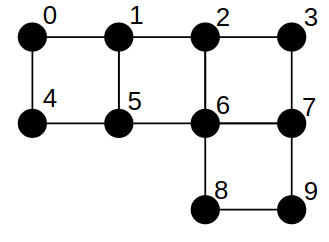
'quadrangle_4'mesh.#1import numpy 2from pysdic.fem import ( 3 compute_elements_neighborhood, 4 remap_integration_points_neighborhood, 5) 6 7connectivity_array = numpy.array([ 8 [0, 1, 4, 5], 9 [1, 2, 5, 6], 10 [2, 3, 6, 7], 11 [6, 7, 8, 9]]) 12 13element_indices = numpy.array([0, 0, 1, 1, 2, 2, 3, 3, -1]) 14 15elements_neighborhood = compute_elements_neighborhood(connectivity_array) 16points_neighborhood = remap_integration_points_neighborhood( 17 elements_neighborhood, element_indices 18) 19 20print(f"points neighborhood (shape={points_neighborhood.shape})") 21for element in range(points_neighborhood.shape[0]): 22 print(f"element {element}: points {points_neighborhood[element].indices}")
points neighborhood (shape=(4, 9))
element 0: points [0 1 2 3]
element 1: points [0 1 2 3 4 5 6 7]
element 2: points [2 3 4 5 6 7]
element 3: points [2 3 4 5 6 7]