pysdic.fem.compute_integration_points_neighborhood#
- compute_integration_points_neighborhood(connectivity_array, element_indices, *, max_distance=1, self_neighborhood=True, skip_m1=True)[source]#
Compute, for each element of a mesh, the integration points located in the elements of its neighborhood.
Convenience function that combines
pysdic.fem.compute_elements_neighborhood()andpysdic.fem.remap_integration_points_neighborhood().Note
Inputs
connectivity_arrayandelement_indiceswill be converted tonumpy.int64.
Important
With
skip_m1=True, the points with element index-1(outside the mesh) belong to no neighborhood. Withskip_m1=False, negative element indices raise anIndexError.- Parameters:
connectivity_array (ArrayLike) – An array of shape \((N_{e}, N_{vpe})\) defining the connectivity of the elements in the mesh, where each row contains the indices of the vertices that form an element.
element_indices (ArrayLike) – An array of shape \((N_{p},)\) containing the indices of the element of each of the \(N_{p}\) integration points.
max_distance (Integral, optional (default:
1)) – The maximum distance of the elements in the neighborhood. With 1, only the elements sharing a vertex are included.self_neighborhood (bool, optional (default:
True)) – If True, the neighborhood of each element includes the element itself (and so its own integration points).skip_m1 (bool, optional (default:
True)) – If set to True, the points with element index-1are ignored.
- Returns:
points_neighborhood – A boolean sparse matrix of shape \((N_{e}, N_{p})\), where the integration points in the neighborhood of element \(i\) are
points_neighborhood[i].indices(sorted).- Return type:
See also
pysdic.fem.compute_elements_neighborhoodNeighborhood of each element of a mesh.
pysdic.fem.remap_integration_points_neighborhoodRemap a neighborhood of the elements to the integration points.
Examples
Create a simple
'quadrangle_4'mesh with 10 vertices and 4 elements, with two integration points per element, and compute the integration points in the neighborhood of each element.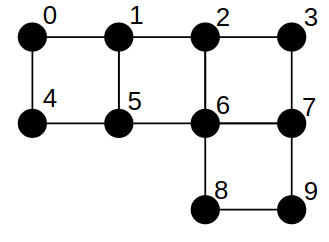
'quadrangle_4'mesh.#1import numpy 2from pysdic.fem import compute_integration_points_neighborhood 3 4connectivity_array = numpy.array([ 5 [0, 1, 4, 5], 6 [1, 2, 5, 6], 7 [2, 3, 6, 7], 8 [6, 7, 8, 9]]) 9 10element_indices = numpy.array([0, 0, 1, 1, 2, 2, 3, 3]) 11 12points_neighborhood = compute_integration_points_neighborhood( 13 connectivity_array, element_indices, max_distance=1 14) 15 16print(f"points neighborhood (shape={points_neighborhood.shape})") 17for element in range(points_neighborhood.shape[0]): 18 print(f"element {element}: points {points_neighborhood[element].indices}")
points neighborhood (shape=(4, 8))
element 0: points [0 1 2 3]
element 1: points [0 1 2 3 4 5 6 7]
element 2: points [2 3 4 5 6 7]
element 3: points [2 3 4 5 6 7]