pysdic.fem.get_segment_2_gauss_points#
- get_segment_2_gauss_points(return_weights=False)[source]#
Get the natural coordinates \(\xi\) and weights of Gauss quadrature points for a 2-node segment element.
The 1-point Gauss-Legendre rule is used. It integrates exactly polynomials up to degree 1 over the reference segment \([-1, 1]\).
- Parameters:
return_weights (bool, optional (default:
False)) – If True, the function will also return the weights associated with each Gauss point.- Returns:
gauss_points (numpy.ndarray) – Natural coordinates of the Gauss points. The returned array has shape \((1, 1)\).
weights (numpy.ndarray) – Only returned if
return_weightsis True. Weights associated with each Gauss point, with shape \((1,)\). They sum to \(2\), the length of the reference segment.
- Return type:
Notes
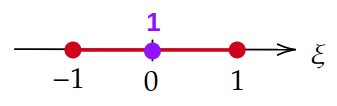
A 2-node segment element uses the following Gauss points and weights for numerical integration:
Point No.
\((\xi)\)
Weight \(w\)
1
\(0\)
\(2\)
See also
pysdic.fem.compute_segment_2_shape_functionsShape functions for 2-node segment 1D-elements.
pysdic.fem.get_gauss_pointsGauss points for any supported element type.
Examples
Get the Gauss points for a 2-node segment element:
1import numpy
2from pysdic.fem import get_segment_2_gauss_points
3
4gauss_points = get_segment_2_gauss_points()
5print("Gauss points:")
6print(gauss_points)
Gauss points:
[[0.]]