Note
Go to the end to download the full example code.
Controlling the quality of a measure#
After a measure, pysdic.workflows gives two controls:
pysdic.workflows.compute_elements_residual_rms(): the RMS of the residuals per element and per pairing, and the badly correlated elements (reflections, occlusions);pysdic.workflows.compute_uncertainty(): the covariance of the displacements from the Jacobian of the term and the noise of the images.
Important
Requires the optional package open3d (ray casting of the 3D surface).
A measure with a reflection#
The plate of Measuring a displacement with the SDIC moves between the frames 0 and 1, with a noise of 1 gray level. In the image of the first camera at the frame 1, a reflection saturates a disk of 10 pixels around the point \((0.5, 0.25, 0)\) of the plate.
import numpy
from pysdic import (
    Camera, Image, PerspectiveExtrinsic, PinholeIntrinsic, add_gaussian_noise, compute_projected_roi,
    compute_wave_speckle, create_3d_quadrangle_4_heightmap, create_bicamera_analysis, generate_synthetic_image,
    quantize_image,
)

height, width = 180, 240
cameras = [
    Camera(
        height, width,
        extrinsic=PerspectiveExtrinsic.from_rt(rvec=[numpy.pi, side * 0.15, 0.0], tvec=[side * 0.6, 0.0, 5.0]),
        intrinsic=PinholeIntrinsic.from_matrix([[300.0, 0.0, 120.0], [0.0, 300.0, 90.0], [0.0, 0.0, 1.0]]),
    )
    for side in (1, -1)
]

plate = create_3d_quadrangle_4_heightmap(x_bounds=(-2.5, 2.5), y_bounds=(-2.0, 2.0), n_x=41, n_y=33)
x, y = numpy.linspace(-2.5, 2.5, 500), numpy.linspace(2.0, -2.0, 400)
texture = compute_wave_speckle(numpy.stack(numpy.meshgrid(x, y), axis=-1), wavelength=0.15)


def true_displacement(points: numpy.ndarray) -> numpy.ndarray:
    x, y = points[:, 0], points[:, 1]
    return numpy.stack((0.04 + 0.02 * y, -0.03 + 0.01 * x, 0.05 + 0.02 * x), axis=1)


mesh = create_3d_quadrangle_4_heightmap(x_bounds=(-1.0, 1.0), y_bounds=(-0.6, 0.6), n_x=7, n_y=5)
truth = true_displacement(mesh.coordinates)
reflection = numpy.array([[0.5, 0.25, 0.0]])


def acquire(camera: Camera, frame: int, seed: int, reflect: bool = False) -> Image:
    rendered = generate_synthetic_image(camera, plate, texture, displacement=frame * true_displacement(plate.coordinates), n_samples=2)
    data = add_gaussian_noise(rendered[..., 0], std=1.0, seed=seed)
    if reflect:
        cx, cy = camera.project(reflection + true_displacement(reflection)).image_points[0]
        rows, columns = numpy.mgrid[0:height, 0:width]
        data[(columns - cx) ** 2 + (rows - cy) ** 2 <= 10.0**2] = 255.0
    data = quantize_image(data, bit_depth=8)
    return Image.from_array(data, roi=compute_projected_roi(mesh, camera, warp_by=frame * truth, margin=10))


images = [
    [acquire(camera, frame, seed=2 * frame + k, reflect=(k == 0 and frame == 1)) for frame in range(2)]
    for k, camera in enumerate(cameras)
]
analysis = create_bicamera_analysis(mesh, cameras[0], cameras[1], images[0], images[1])
analysis.set_zero_displacement(0)
The displacement of the frame 1 is measured with the temporal pairings of both cameras and the stereo pairing of the frame 1, without gray level correction (same lighting).
import pysolvegn
from pysdic import Pairing, SDICCorrelationTerm, SDICUnknowns
from pysdic.workflows import create_grid_integration_points

pairings = [Pairing.temporal(0, 0, 1), Pairing.temporal(1, 0, 1), Pairing.stereo(1, 0, 1)]
analysis.set_displacement(1, 0.7 * truth)
unknowns = SDICUnknowns([1], [])


def measure(correlation: SDICCorrelationTerm) -> SDICCorrelationTerm:
    analysis.set_displacement(1, 0.7 * truth)  # Same initial guess for each measure
    result = pysolvegn.solve(terms=[correlation.term], p0=analysis.pack_unknowns(unknowns), max_iteration=30)
    analysis.apply_unknowns(unknowns, result.parameters)
    print(f"Maximum error on the displacement: {numpy.abs(analysis.get_displacement(1) - truth).max():.2e}")
    return correlation


correlation = measure(SDICCorrelationTerm(analysis, unknowns, create_grid_integration_points(mesh, 6), pairings))
Maximum error on the displacement: 1.37e-01
Badly correlated elements#
The RMS of the residuals of each element is compared with the other elements of the
pairing (median and robust spread): the elements of the reflection stand out in the two
pairings that use the view (1, 0).
import matplotlib.pyplot as plt
from pysdic import ImagePlotter
from pysdic.workflows import compute_elements_residual_rms

quality = compute_elements_residual_rms(analysis, correlation.integration_points, correlation.compute_residuals())
for pairing, rms, outliers in zip(quality.pairings, quality.pairing_rms, quality.outliers):
    print(f"{pairing}: RMS {rms:.1f} gray levels, outliers {numpy.flatnonzero(outliers)}")
print(f"Badly correlated elements: {quality.bad_elements}")

fig, axes = plt.subplots(1, 3, figsize=(16, 4))
for ax, pairing, rms in zip(axes, quality.pairings, quality.rms):
    plotter = ImagePlotter(analysis.get_view(*pairing.view_2), ax=ax)
    plotter.add_image()
    plotter.add_mesh(
        mesh, warp_by=analysis.get_displacement(1), element_property=rms, property_cmap="viridis",
        face_opacity=0.7, show_vertices=False, show_bar=True,
    )
    plotter.set_title(f"RMS per element, {pairing}")
plt.show()
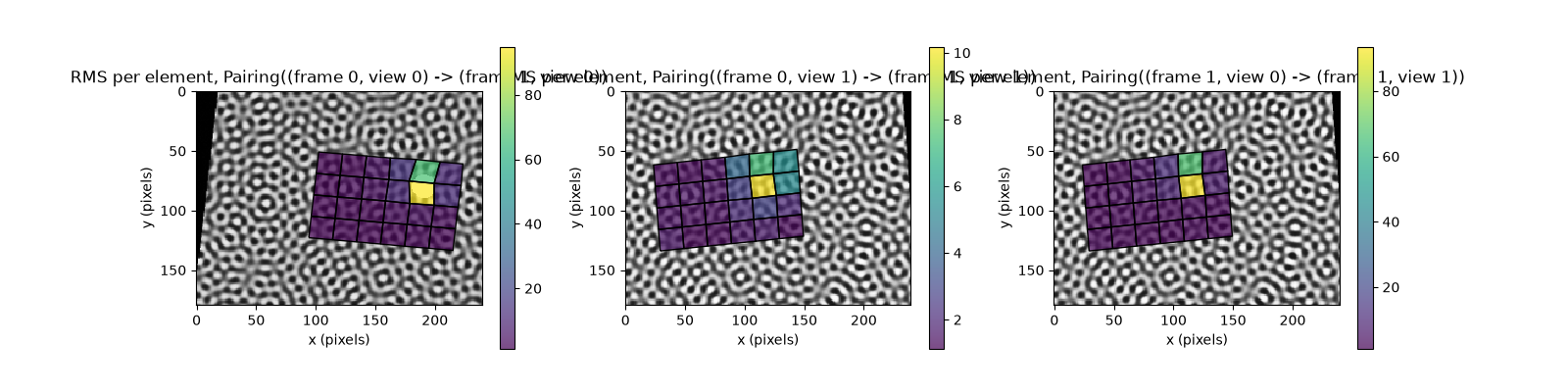
Pairing((frame 0, view 0) -> (frame 1, view 0)): RMS 24.3 gray levels, outliers [15 16 17 21 22 23]
Pairing((frame 0, view 1) -> (frame 1, view 1)): RMS 3.5 gray levels, outliers [16 17 21 22 23]
Pairing((frame 1, view 0) -> (frame 1, view 1)): RMS 23.8 gray levels, outliers [14 15 16 17 20 21 22 23]
Badly correlated elements: [14 15 16 17 20 21 22 23]
The integration points of the bad elements are removed and the frame is measured again,
with a new term on the same unknowns (pysdic.SDICCorrelationTerm.with_integration_points()).
Maximum error on the displacement: 2.10e-02
Uncertainty of the displacements#
The covariance \(s^2 H^{-1} (J^T W J) H^{-1}\) of the displacement of each vertex comes from the Jacobian of the term at convergence. The variance \(s^2\) of the residuals is estimated from the residuals (default), or given by the noise of the images (\(s^2 = 2 \sigma^2\), here \(\sigma \approx 1\) gray level with the quantization): both agree when the residuals only come from the noise.
from pysdic.workflows import compute_uncertainty

estimated = compute_uncertainty(correlation)
from_noise = compute_uncertainty(correlation, image_noise_std=1.0)
print(f"Residual variance: {estimated.residual_variance:.2f} (residuals), {from_noise.residual_variance:.2f} (noise)")

std = estimated.standard_deviations[1]  # (N_v, 3)
error = numpy.abs(analysis.get_displacement(1) - truth)
for c, name in enumerate("XYZ"):
    print(f"{name}: median standard deviation {numpy.nanmedian(std[:, c]):.1e}, RMS error {numpy.sqrt(numpy.mean(error[:, c]**2)):.1e}")
Residual variance: 477.36 (residuals), 2.00 (noise)
X: median standard deviation 4.4e-03, RMS error 1.2e-02
Y: median standard deviation 4.5e-03, RMS error 9.2e-03
Z: median standard deviation 1.7e-02, RMS error 1.6e-02
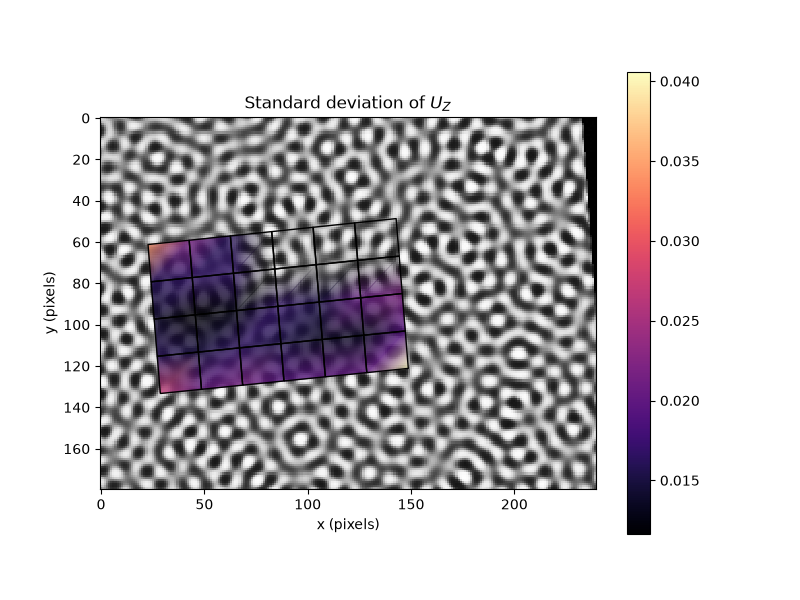
The standard deviation of \(U_Z\), interpolated on the faces from the vertices: the out-of-plane component is the least precise (it only comes from the stereo angle), and the vertices on the border of the mesh, supported by fewer points, are less precise than the inner ones.
plotter = ImagePlotter(analysis.get_view(1, 1))
plotter.add_image()
plotter.add_mesh(
    mesh, warp_by=analysis.get_displacement(1), vertex_property=std[:, 2], property_cmap="magma",
    face_opacity=0.8, show_vertices=False, show_bar=True,
)
plotter.set_title("Standard deviation of $U_Z$")
plotter.show()
Total running time of the script: (0 minutes 2.477 seconds)