Note
Go to the end to download the full example code.
Measuring a displacement with the SDIC#
This example measures the 3D displacement of a plate seen by two cameras between two
frames, with a pysdic.SDICCorrelationTerm solved by pysolvegn. The images are
synthetic, with a change of lighting between the frames compensated by a ZNSSD gray level
correction.
Important
Requires the optional package open3d (ray casting of the 3D surface).
Synthetic stereo images#
Two cameras look at a speckled plate from 5 units above. Between the frames 0 and 1, the
plate moves with an affine displacement field and the lighting changes (gain 1.3, offset
10). The images are rendered with pysdic.generate_synthetic_image() (texture of
pysdic.compute_wave_speckle() through the UV map of the plate), then acquired with
a Gaussian noise of 1 gray level on 8 bits.
import numpy
from pysdic import (
    Camera, Image, PerspectiveExtrinsic, PinholeIntrinsic, add_gaussian_noise, compute_projected_roi,
    compute_wave_speckle, create_3d_quadrangle_4_heightmap, generate_synthetic_image, quantize_image,
)

height, width = 180, 240
cameras = [
    Camera(
        height, width,
        extrinsic=PerspectiveExtrinsic.from_rt(rvec=[numpy.pi, side * 0.15, 0.0], tvec=[side * 0.6, 0.0, 5.0]),
        intrinsic=PinholeIntrinsic.from_matrix([[300.0, 0.0, 120.0], [0.0, 300.0, 90.0], [0.0, 0.0, 1.0]]),
    )
    for side in (1, -1)
]

# Plate of 5 x 4 units, with a texture of 0.01 unit per texel (first row: v = 1, i.e. y max)
plate = create_3d_quadrangle_4_heightmap(x_bounds=(-2.5, 2.5), y_bounds=(-2.0, 2.0), n_x=41, n_y=33)
x = numpy.linspace(-2.5, 2.5, 500)
y = numpy.linspace(2.0, -2.0, 400)
texture = compute_wave_speckle(numpy.stack(numpy.meshgrid(x, y), axis=-1), wavelength=0.15)  # Spots of about 4 pixels


def true_displacement(points: numpy.ndarray) -> numpy.ndarray:
    x, y = points[:, 0], points[:, 1]
    return numpy.stack((0.04 + 0.02 * y, -0.03 + 0.01 * x, 0.05 + 0.02 * x), axis=1)


def acquire(camera: Camera, frame: int, seed: int) -> numpy.ndarray:
    gain, offset = ((1.0, 0.0), (1.3, 10.0))[frame]
    rendered = generate_synthetic_image(camera, plate, texture, displacement=frame * true_displacement(plate.coordinates), n_samples=2)
    return quantize_image(add_gaussian_noise(gain * rendered[..., 0] + offset, std=1.0, seed=seed), bit_depth=8)
The analysis#
The measurement mesh covers the center of the plate. The images are interpolated in the
ROI of the mesh at their frame (see pysdic.compute_projected_roi()), and
pysdic.create_bicamera_analysis() builds the analysis: at each frame, the view 0 is the
first camera and the view 1 the second one (each camera is shared by all the frames).
The frame 0 is the reference (zero displacement). The displacement of the frame 1 is initialized with 70 % of the true displacement, as a previous estimate would be.
from pysdic import create_bicamera_analysis

mesh = create_3d_quadrangle_4_heightmap(x_bounds=(-1.0, 1.0), y_bounds=(-0.6, 0.6), n_x=7, n_y=5)
truth = true_displacement(mesh.coordinates)

images = [
    [
        Image.from_array(acquire(camera, frame, seed=2 * frame + k), roi=compute_projected_roi(mesh, camera, warp_by=frame * truth, margin=10))
        for frame in range(2)
    ]
    for k, camera in enumerate(cameras)
]
analysis = create_bicamera_analysis(mesh, cameras[0], cameras[1], images[0], images[1])
analysis.set_zero_displacement(0)
analysis.set_displacement(1, 0.7 * truth)
print(analysis)
analysis.display_structure("camera")
SDICAnalysis(n_frames=2, n_vertices=35, n_elements=24, n_views=[2, 2])
Structure of the cameras (index of the shared camera of each view):
  Frame 0  : [0, 1]
  Frame 1  : [0, 1]
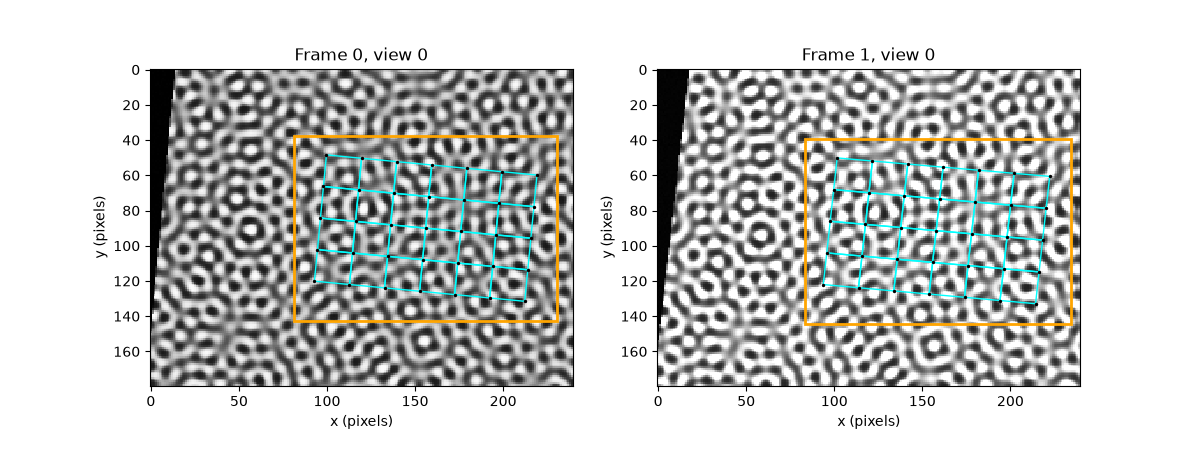
The images of the first camera at both frames, with the mesh at its current displacement and the ROI of the images.
import matplotlib.pyplot as plt
from pysdic import ImagePlotter

fig, axes = plt.subplots(1, 2, figsize=(12, 4.5))
for frame, ax in enumerate(axes):
    plotter = ImagePlotter(analysis.get_view(frame, 0), ax=ax)
    plotter.add_image()
    plotter.add_roi()
    plotter.add_mesh(mesh, warp_by=analysis.get_displacement(frame), show_faces=False, edge_color="cyan", vertex_size=2)
    plotter.set_title(f"Frame {frame}, view 0")
plt.show()
Integration points and safeguards#
The material points are a regular grid of \(6 \times 6\) points per element. Before building the problem, two safeguards check the setup:
pysdic.compute_projected_elements_areas()gives the number of pixels per element (here about 200, for 36 points per element);pysdic.compute_visibility()checks that the points are seen by each view (in the ROI of its image and not hidden by the mesh).
from pysdic import IntegrationPoints, compute_projected_elements_areas, compute_visibility

grid = numpy.linspace(-0.9, 0.9, 6)
natural = numpy.stack(numpy.meshgrid(grid, grid), axis=-1).reshape(-1, 2)  # (36, 2) in the reference quadrangle
integration_points = IntegrationPoints(
    numpy.tile(natural, (mesh.n_elements, 1)), numpy.repeat(numpy.arange(mesh.n_elements), natural.shape[0])
)

for k, camera in enumerate(cameras):
    areas = compute_projected_elements_areas(mesh, camera)
    print(f"Camera {k}: {areas.min():.0f} to {areas.max():.0f} pixels² per element")
for frame in range(2):
    for index, view in enumerate(analysis.get_views(frame)):
        visible = compute_visibility(mesh, integration_points, view, warp_by=analysis.get_displacement(frame))
        print(f"Frame {frame}, view {index}: {visible.sum()} / {visible.size} visible points")
Camera 0: 360 to 360 pixels² per element
Camera 1: 360 to 360 pixels² per element
Frame 0, view 0: 864 / 864 visible points
Frame 0, view 1: 864 / 864 visible points
Frame 1, view 0: 864 / 864 visible points
Frame 1, view 1: 864 / 864 visible points
The correlation term#
The pairings compare each camera between the frames (temporal pairings) and the two
cameras at the frame 1 (stereo pairing, which constrains the out-of-plane displacement).
The unknowns (pysdic.SDICUnknowns) are the displacement of the frame 1, the
cameras are fixed: SDICUnknowns([1], []). The unknowns only describe what is
optimized: the analysis checks them (pysdic.SDICAnalysis.validate_unknowns()) and
builds the vector of unknowns (pysdic.SDICAnalysis.pack_unknowns()). The term is
built on the analysis, the unknowns, the integration points and the pairings. The ZNSSD
correction normalizes the gray levels of the two views of each pairing (scale=255 gives residuals in gray levels), which removes the
change of lighting.
import pysolvegn
from pysdic import Pairing, SDICCorrelationTerm, SDICUnknowns

unknowns = SDICUnknowns([1], [])
pairings = [Pairing.temporal(0, 0, 1), Pairing.temporal(1, 0, 1), Pairing.stereo(1, 0, 1)]
correlation = SDICCorrelationTerm(
    analysis, unknowns, integration_points, pairings, gl_correction={"mode": "ZNSSD", "scale": 255.0}, use_cache=True
)
print(unknowns)
print(correlation)


def rms_residuals(correlation: SDICCorrelationTerm) -> str:
    # RMS of the residuals of each pairing, for the current state of the analysis
    return ", ".join(f"{numpy.sqrt(numpy.nanmean(r.residuals**2)):.1f}" for r in correlation.compute_residuals())


print(f"RMS residuals before: {rms_residuals(correlation)} gray levels")

result = pysolvegn.solve(terms=[correlation.term], p0=analysis.pack_unknowns(unknowns), max_iteration=30)
analysis.apply_unknowns(unknowns, result.parameters)  # Displacement of the frame 1 written in the analysis

print(f"RMS residuals after:  {rms_residuals(correlation)} gray levels ({result.n_iterations} iterations)")
print(f"Maximum error on the displacement: {numpy.abs(0.7 * truth - truth).max():.2e} (initial) -> "
      f"{numpy.abs(analysis.get_displacement(1) - truth).max():.2e} (measured)")
SDICUnknowns(optimized_frames=[1], optimized_transformations=[])
SDICCorrelationTerm(mode='rJ', 3 pairings, optimized_frames=[1], optimized_transformations=[], 864 integration points, n_unknowns=105, sparse=True, use_cache=True)
RMS residuals before: 135.6, 115.2, 30.3 gray levels
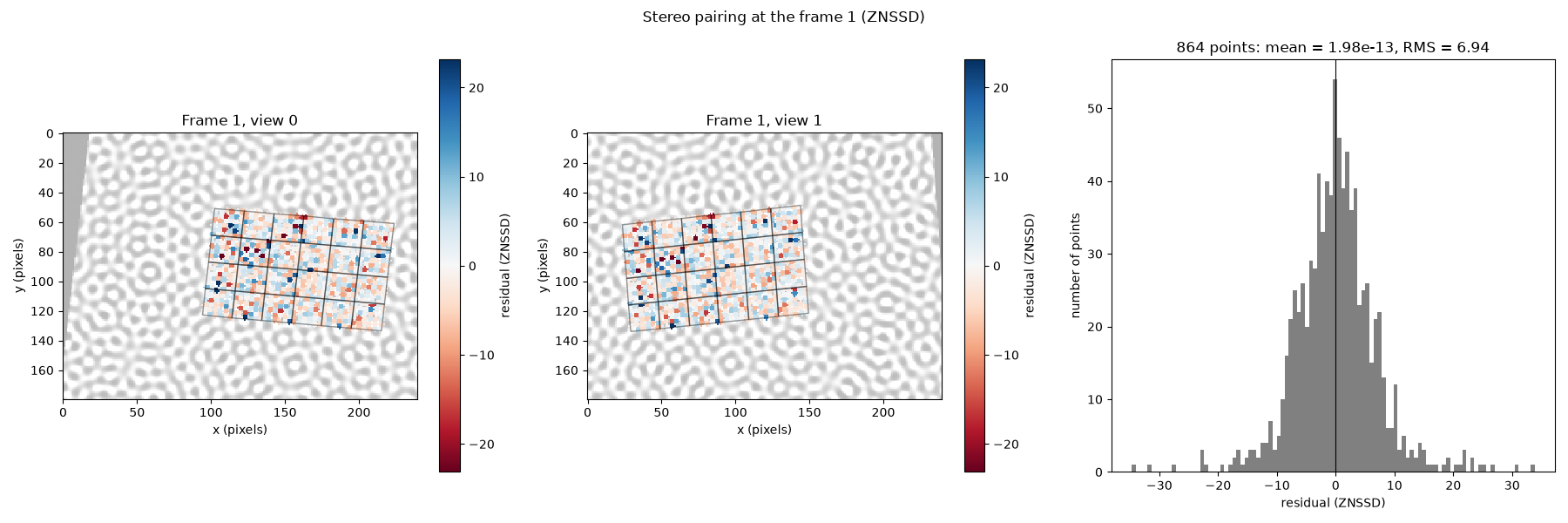
RMS residuals after:  34.5, 34.3, 6.9 gray levels (30 iterations)
Maximum error on the displacement: 2.10e-02 (initial) -> 3.90e-03 (measured)
Residual maps#
pysdic.SDICCorrelationTerm.compute_residuals() gives the residuals compared by the
term (ZNSSD gray levels), drawn on the two views by pysdic.display_residual_maps().
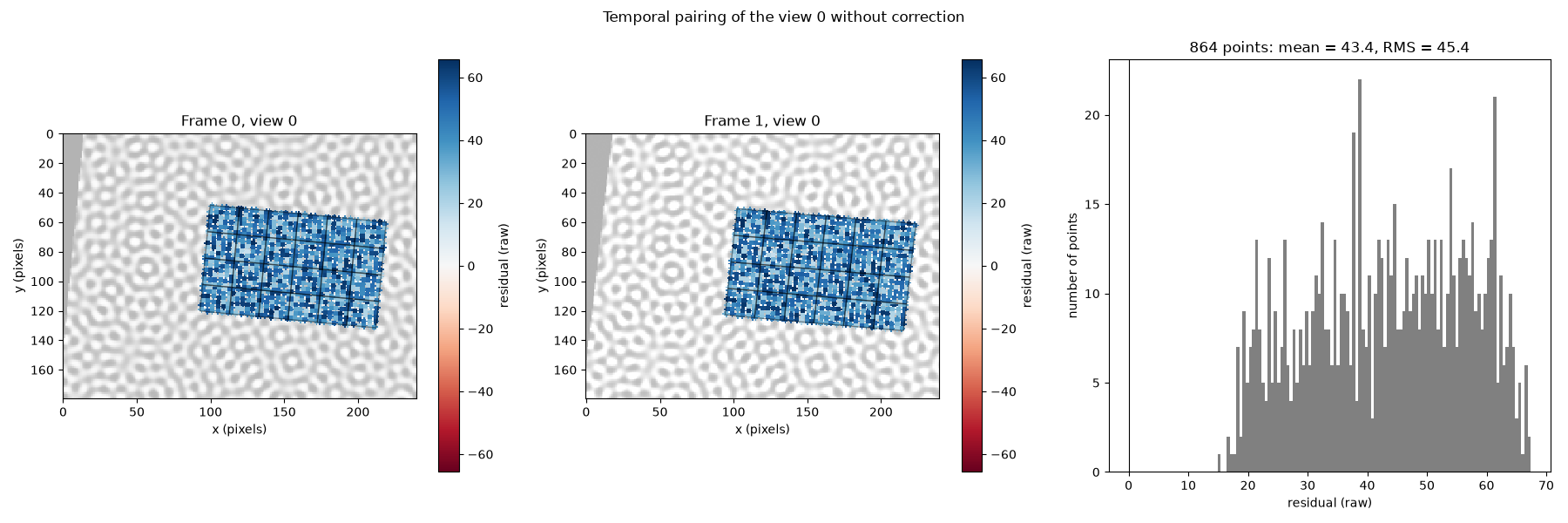
With pysdic.compute_residuals() and no gray level correction, the raw residuals of the
temporal pairing keep the change of lighting between the frames.
from pysdic import compute_residuals, display_residual_maps

stereo_residuals = correlation.compute_residuals()[2]
display_residual_maps(analysis, stereo_residuals, fill_radius=2.0, title="Stereo pairing at the frame 1 (ZNSSD)")

raw_residuals = compute_residuals(analysis, Pairing.temporal(0, 0, 1), integration_points)
display_residual_maps(analysis, raw_residuals, fill_radius=2.0, title="Temporal pairing of the view 0 without correction")
<Figure size 1800x600 with 5 Axes>
Total running time of the script: (0 minutes 3.062 seconds)