pyzernike.xy_zernike_parameter_derivative#
- pyzernike.xy_zernike_parameter_derivative(x: ndarray, y: ndarray, n: Integral | Sequence[Integral] | ndarray, m: Integral | Sequence[Integral] | ndarray, parameter: str | Sequence[str] | ndarray, Rx: Real | None = 1.0, Ry: Real | None = 1.0, x0: Real | None = 0.0, y0: Real | None = 0.0, alpha: Real | None = 0.0, h: Real | None = 0.0, default: int | float = nan, *, precompute: bool = True, normalize: bool = False, to_list: bool = True) ndarray | List[ndarray][source]#
Compute the first order derivatives of the Zernike polynomials on an elliptic annulus [1] with respect to the parameters \((x_0, y_0, R_x, R_y, \alpha, h)\) of the annulus, at fixed Cartesian coordinates \((x, y)\).
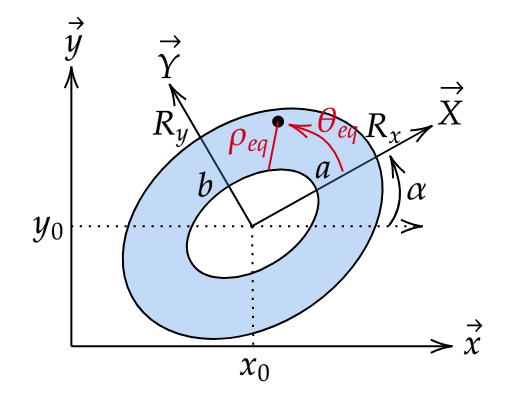
The parameters of the elliptic annulus domain.#
The Zernike polynomials on the elliptic annulus are \(Zxy_{n}^{m}(x, y) = Z_{n}^{m}\left(\rho_{eq}, \theta_{eq}\right)\) (see
pyzernike.xy_zernike_polynomial()). These derivatives are used to refine the domain of definition, e.g. to fit the parameters of the annulus with a Gauss-Newton algorithm: for a surface \(W = \sum_j c_j Zxy_{j}\), \(\frac{\partial W}{\partial p} = \sum_j c_j \frac{\partial Zxy_{j}}{\partial p}\). The residual and Jacobian functions of such a fit are directly given bypyzernike.xy_zernike_least_squares().Let \(u = X / R_x\) and \(v = Y / R_y\), where \(X = c (x - x_0) + s (y - y_0)\) and \(Y = -s (x - x_0) + c (y - y_0)\) are the coordinates in the frame of the ellipse (\(c = \cos\alpha\), \(s = \sin\alpha\)). The polynomial depends on \((x_0, y_0, R_x, R_y, \alpha)\) only through \((u, v)\), so with \(Z_u = \partial_u Zxy_{n}^{m}\) and \(Z_v = \partial_v Zxy_{n}^{m}\):
\[\frac{\partial Zxy_{n}^{m}}{\partial x_0} = -\frac{c}{R_x} Z_u + \frac{s}{R_y} Z_v \quad \text{and} \quad \frac{\partial Zxy_{n}^{m}}{\partial y_0} = -\frac{s}{R_x} Z_u - \frac{c}{R_y} Z_v\]\[\frac{\partial Zxy_{n}^{m}}{\partial R_x} = -\frac{u}{R_x} Z_u \quad \text{and} \quad \frac{\partial Zxy_{n}^{m}}{\partial R_y} = -\frac{v}{R_y} Z_v \quad \text{and} \quad \frac{\partial Zxy_{n}^{m}}{\partial \alpha} = \frac{R_y}{R_x} v Z_u - \frac{R_x}{R_y} u Z_v\]The parameter \(h\) appears only in \(\rho_{eq} = \frac{r - h}{1 - h}\) (\(r = \sqrt{u^2 + v^2}\)), so:
\[\frac{\partial Zxy_{n}^{m}}{\partial h} = \frac{\rho_{eq} - 1}{1 - h} \frac{\partial Z_{n}^{m}}{\partial \rho}(\rho_{eq}, \theta_{eq})\]\(Z_u\) and \(Z_v\) are computed as in
pyzernike.xy_zernike_polynomial(), without singularity at the center of the ellipse.If \(|m| > n\) or \(n - m\) is odd, the derivative is zero.
Where the point is outside the elliptic annulus (\(\rho_{eq}\) outside \([0, 1]\)), or the coordinates are not finite, the output is set to
default.
Note
The derivatives are those of the value of the polynomial at a fixed point inside the annulus. The domain itself depends on the parameters: when they change, points may enter or leave the annulus, which is not differentiable. During an optimization, keep the set of points fixed within an iteration (or discard the points close to the boundary), and keep \(h\) in \([0, 1)\) (the derivative with respect to \(h\) at \(h = 0\) is the right derivative). The parameters can not be estimated together with the coefficients for a full ellipse (see the page Fitting).
Shape of the inputs and of the output.
n,mandparametercan each be a single value or a sequence (list, tuple or 1D numpy array):If all of them are single values, a single derivative is computed and returned as an array with the shape of
x.If at least one of them is a sequence, the single values are repeated to the length \(N\) of the sequences (which must all have the same length), and \(N\) derivatives are computed. They are returned as a list of \(N\) arrays with the shape of
x(to_list=True), or as a single array of shape \((N, \dots)\) (to_list=False).
See also
pyzernike.xy_zernike_polynomial()to compute the Zernike polynomials on the elliptic annulus and their derivatives with respect to \(x\) and \(y\).pyzernike.cartesian_to_elliptic_annulus()to compute the equivalent polar coordinates.pyzernike.xy_zernike_least_squares()for the residual and Jacobian functions of the fit of the parameters of the annulus.The page Extension to an elliptic annulus for the derivatives with respect to the parameters of the annulus.
The page Fitting for the estimation of the parameters of the annulus.
- Parameters:
x (numpy.ndarray) – The x Cartesian coordinates with any shape
(...).y (numpy.ndarray) – The y Cartesian coordinates with the same shape as
x. Ifxandyare floating point arrays of the same dtype (e.g.numpy.float32), this dtype is kept. Otherwise, both are converted tonumpy.float64.n (Union[Integral, Sequence[Integral], numpy.ndarray]) – The radial order(s) \(n\).
m (Union[Integral, Sequence[Integral], numpy.ndarray]) – The azimuthal frequency(ies) \(m\).
parameter (Union[str, Sequence[str], numpy.ndarray]) – The parameter(s) with respect to which the polynomials are derived, among
"x0","y0","Rx","Ry","alpha"and"h".Rx (Optional[Real], optional) – The semi-axis \(R_x\) of the ellipse along its x axis. Must be finite and strictly positive. Default is 1.0.
Ry (Optional[Real], optional) – The semi-axis \(R_y\) of the ellipse along its y axis. Must be finite and strictly positive. Default is 1.0.
x0 (Optional[Real], optional) – The x coordinate \(x_0\) of the center of the ellipse. Must be finite. Default is 0.0.
y0 (Optional[Real], optional) – The y coordinate \(y_0\) of the center of the ellipse. Must be finite. Default is 0.0.
alpha (Optional[Real], optional) – The rotation angle \(\alpha\) of the ellipse in radians. Must be finite. Default is 0.0.
h (Optional[Real], optional) – The ratio \(h\) of the inner to the outer semi-axes, in \([0, 1)\). Default is 0.0 (full ellipse).
default (Union[int, float], optional) – The value set outside the elliptic annulus or where the coordinates are not finite. Integers and floating point numbers (Python or numpy, including
numpy.nanandnumpy.inf) are accepted and converted to float. Booleans are not accepted. Default isnumpy.nan.precompute (bool, optional) – If True, the powers of \(\rho_{eq}\) and the cosine and sine terms are cached and shared between the polynomials, which is faster when several derivatives are computed at once. If False, they are recomputed for each polynomial, which uses less memory. Default is True.
normalize (bool, optional) – If True, the derivatives are multiplied by the normalization factors of Noll \(N_{n}^{m} = \sqrt{(2 - \delta_{m0})(n + 1)}\) (see
pyzernike.zernike_normalization()). The valuedefaultis not normalized. Default is False.to_list (bool, optional) – Only used when several derivatives are computed. If True, the output is a list of arrays. If False, the output is a single array of shape \((N, \dots)\). Default is True.
ellipse (None is accepted for all the parameters of the)
value. (and means the default)
- Returns:
If
n,mandparameterare single values: an array with the shape ofx.Otherwise, if
to_listis True: a list of \(N\) arrays with the shape ofx.Otherwise: an array of shape \((N, \dots)\), where
output[i]is the derivative of the polynomial(n[i], m[i])with respect toparameter[i].
The dtype is the common floating point dtype of
xandy(numpy.float64by default).- Return type:
Union[numpy.ndarray, List[numpy.ndarray]]
- Raises:
TypeError – If
xorycan not be converted to a floating point array, if a parameter of the ellipse is not a real number, ifdefaultis not an integer or a floating point number, ifnormis not an integer or a sequence of integers, ifparameteris not a string or a sequence of strings, or ifprecompute,normalizeorto_listis not a boolean.ValueError – If
xandydo not have the same shape, if a parameter of the ellipse is not finite, ifRxorRyis not strictly positive, ifhis not in \([0, 1)\), ifparametercontains an unknown name, or if the sequences do not have the same length.
References
Examples
Compute the derivative of the defocus \(Z_{2}^{0}\) with respect to the center \(x_0\) of a circle of radius 10 centered at \((1, 1)\):
import numpy
from pyzernike import xy_zernike_parameter_derivative

X, Y = numpy.meshgrid(numpy.linspace(-10, 10, 100), numpy.linspace(-10, 10, 100))
dZ_dx0 = xy_zernike_parameter_derivative(X, Y, n=2, m=0, parameter="x0", Rx=10, Ry=10, x0=1.0, y0=1.0)
Compute the gradient of \(Z_{2}^{0}\) with respect to all the parameters (
nandmare repeated):parameters = ["x0", "y0", "Rx", "Ry", "alpha", "h"] gradient = xy_zernike_parameter_derivative(X, Y, n=2, m=0, parameter=parameters, Rx=10, Ry=10, x0=1.0, y0=1.0, to_list=False) # array of shape (6, 100, 100)