pygraphs.tarjan_components#
- tarjan_components(graph, *, _skip_check=False)[source]#
Compute the strongly connected components (SCC) of a directed graph using Tarjan’s algorithm.
A strongly connected component is a maximal set of vertices such that every vertex is reachable from every other vertex in both directions.
In other words, for any vertices u and v in the same component: there exists a path from u to v and a path from v to u.
- Parameters:
graph (Graph) – An instance of the Graph class representing a directed graph on which strongly connected components will be computed.
_skip_check (bool, optional (default:
False)) – If True, skip input validation checks for performance reasons.
- Returns:
A list of strongly connected components. Each component is represented as a list of vertex indices.
The order of components is not guaranteed.
If the graph is empty, an empty list is returned.
- Return type:
List[List[int]]
Notes
Tarjan’s algorithm computes strongly connected components in a single DFS traversal.
It maintains:
an index counter assigning a unique discovery time to each node,
a low-link value representing the smallest index reachable from a node,
a stack of active nodes currently in the DFS recursion tree.
A node is identified as the root of a strongly connected component when: lowlink[node] == index[node].
At this point, all nodes on the stack up to that node form a complete SCC.
Complexity:
Time complexity: \(O(V + E)\)
Space complexity: \(O(V)\)
Unlike Kosaraju’s algorithm, Tarjan does not require reversing the graph or performing multiple DFS passes.
See also
pygraphs.dfs()Core depth-first search traversal.
pygraphs.kosaraju_components()Alternative SCC algorithm based on two DFS passes.
Examples
Create a simple directed graph of 7 vertices and compute its strongly connected components.
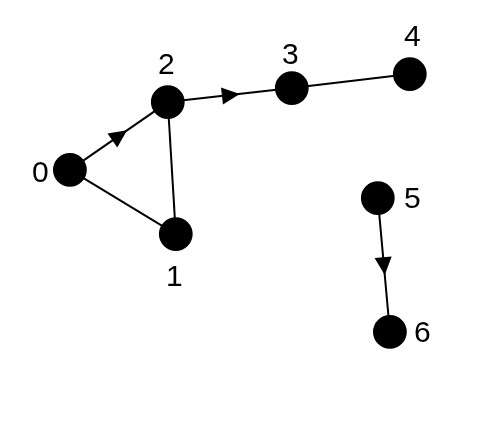
Directed graph with 7 vertices. Strongly connected components are: {0, 1, 2}, {3, 4}, {5}, {6}.#
1from pygraphs import tarjan_components, Graph
2
3graph = [[1, 2], [0, 2], [1, 0, 3], [4], [3], [6], []]
4graph = Graph.from_adjacency(graph)
5
6components = tarjan_components(graph)
7print(components)
[[0, 1, 2], [3, 4], [5], [6]]