pygraphs.bfs_components#
- bfs_components(graph, *, strongly_connected=False, scc_mode='tarjan', _skip_check=False)[source]#
Extract the connected components (or strongly connected components if
strongly_connected=True) of the graph.Note
Vertices A and B are in the same component if :
connected component: there is a path from vertex A to vertex B OR from vertex B to vertex A.
strongly connected component : there is a path from vertex A to vertex B AND from vertex B to vertex A.
- Parameters:
graph (Graph) – An instance of the Graph class representing the graph to be traversed.
strongly_connected (bool (default:
False)) – Compute the strongly connected components instead.scc_mode (str (default:
'tarjan')) – The efficient method to compute strongly connected components. Available options are'tarjan'or'kosaraju'._skip_check (bool)
- Returns:
A list of lists, where each inner list represents a connected component of the graph. Each connected component is a list of vertex indices that are reachable from each other. If the graph is empty, an empty list is returned.
- Return type:
List[List[int]]
Notes
For
strongly_connected=False, considering the undirected graph associated with the provided, a BFS is performed starting from an unvisited vertex, and all vertices that are reachable from that vertex are added to the same component.For
strongly_connected=True, call Tarjan or Kosaraju algorithm.See also
pygraphs.bfs()Core implementation of BFS.
pygraphs.bfs_reachable()Perform a breadth-first search (BFS) to extract the vertices that are reachable from a starting vertex in the graph.
Examples
Create a simple disconnected graph of 7 vertices and compute the connected components of the graph.
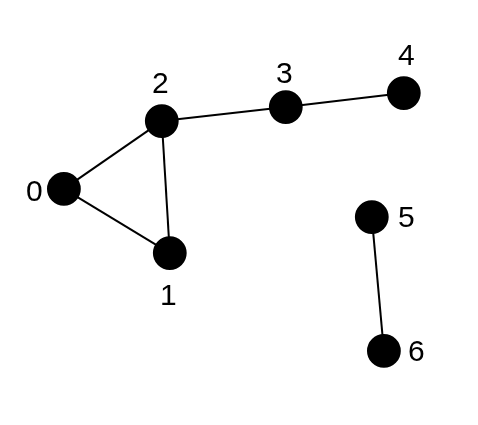
Disconnected graph with 7 vertices for BFS example. The graph has 2 connected components: {0, 1, 2, 3, 4} and {5, 6}.#
1from pygraphs import bfs_components, Graph
2
3graph = [[1, 2], [0, 2], [0, 1, 3], [2, 4], [3], [6], [5]]
4graph = Graph.from_adjacency(graph)
5
6components = bfs_components(graph)
7print(components)
[[0, 1, 2, 3, 4], [5, 6]]This method can be applied for directed graphs as well, where the adjacency list represents the outgoing neighbors of each vertex.
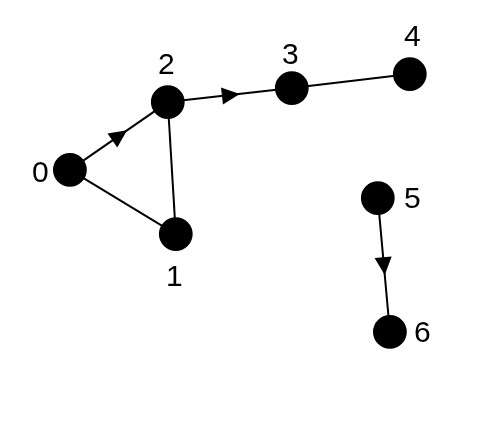
Directed graph with 7 vertices for BFS example. The graph has 2 connected components: {0, 1, 2, 3, 4}, {5,6} using
strongly_connected=Falseand 4 connected components: {0, 1, 2}, {3, 4}, {5} and {6} usingstrongly_connected=True.#1from pygraphs import bfs_components, Graph 2 3graph = [[1, 2], [0, 2], [1, 3], [4], [3], [6], []] 4graph = Graph.from_adjacency(graph) 5 6components = bfs_components(graph, strongly_connected=False) 7print(components)
[[0, 1, 2, 3, 4], [5, 6]]1from pygraphs import bfs_components, Graph 2 3graph = [[1, 2], [0, 2], [1, 3], [4], [3], [6], []] 4graph = Graph.from_adjacency(graph) 5 6components = bfs_components(graph, strongly_connected=True) 7print(components)
[[0, 1, 2], [3, 4], [5], [6]]