Note
Go to the end to download the full example code.
Stereo images of a deforming specimen#
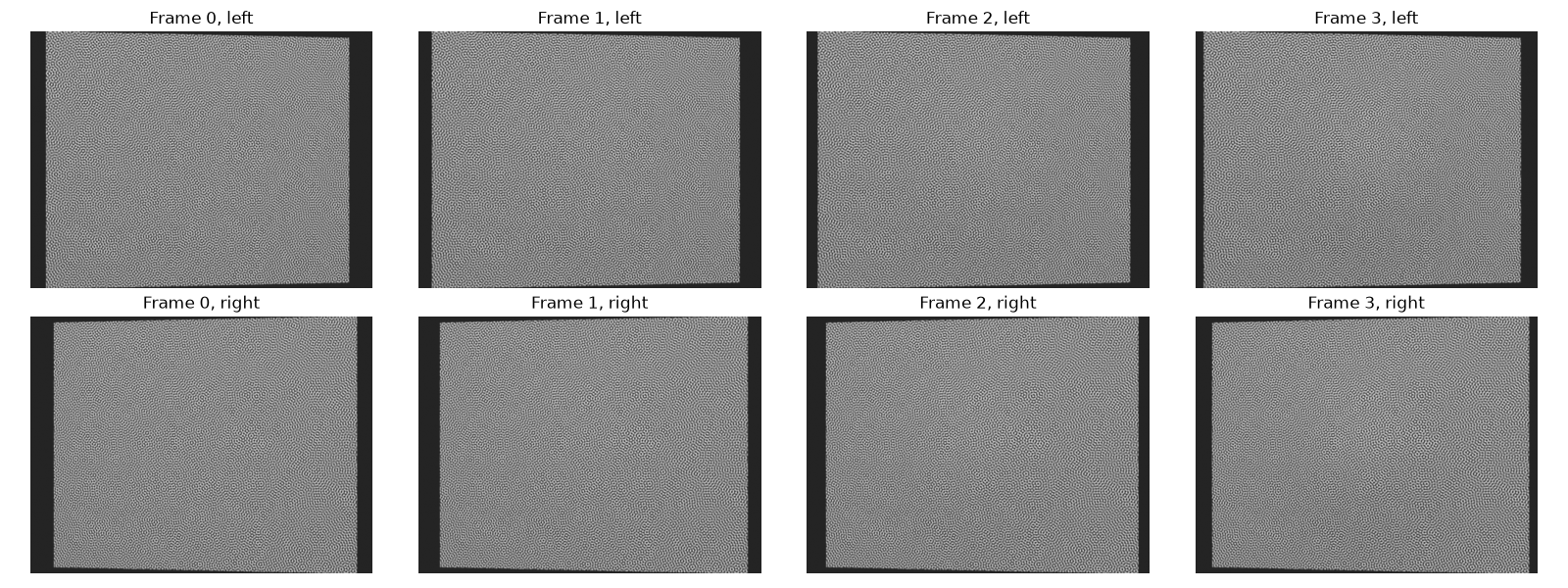
A stereo DIC test needs the images of both cameras at each frame of the deformation. This example builds the scene once (two cameras, two lights, a speckled plate), then updates the vertices of the plate with the displacement of each frame and renders both cameras. The setup is saved to JSON files to regenerate the images later.
Important
Requires pysdic-blender (pip install pysdic-blender), which installs bpy.
Cameras and specimen#
Two cameras at ±15° around the \(y\) axis, 500 mm from a plate of 100 x 80 mm (in mm).
import numpy
from scipy.spatial.transform import Rotation
from pysdic import Camera, PerspectiveExtrinsic, PinholeIntrinsic, compute_wave_speckle, create_3d_triangle_3_heightmap


def stereo_camera(angle):
    # Camera 500 mm from the origin, rotated by `angle` around the y axis, looking at the origin
    rotation = Rotation.from_rotvec([0.0, angle, 0.0]).as_matrix() @ numpy.diag([1.0, -1.0, -1.0])
    rotation = rotation.T  # World-to-camera
    position = 500.0 * numpy.array([numpy.sin(angle), 0.0, numpy.cos(angle)])
    return Camera(
        360, 480,
        extrinsic=PerspectiveExtrinsic.from_rt(
            rvec=Rotation.from_matrix(rotation).as_rotvec().tolist(), tvec=(-rotation @ position).tolist()
        ),
        intrinsic=PinholeIntrinsic.from_matrix([[2200.0, 0.0, 239.5], [0.0, 2200.0, 179.5], [0.0, 0.0, 1.0]]),
    )


cameras = {"left": stereo_camera(numpy.radians(-15.0)), "right": stereo_camera(numpy.radians(15.0))}
plate = create_3d_triangle_3_heightmap(x_bounds=(-50.0, 50.0), y_bounds=(-40.0, 40.0), n_x=101, n_y=81)
x, y = numpy.linspace(-50.0, 50.0, 1000), numpy.linspace(40.0, -40.0, 800)  # First row: v = 1
speckle = compute_wave_speckle(numpy.stack(numpy.meshgrid(x, y), axis=-1), wavelength=0.8)
Displacements#
At the frame \(k\), a stretching of \(1.5 k\) % along \(x\) and an out-of-plane bulge of \(2 k\) mm in the center of the plate.
coordinates = numpy.asarray(plate.coordinates)
displacements = {}
for frame in range(4):
    displacement = numpy.zeros_like(coordinates)
    displacement[:, 0] = 0.015 * frame * coordinates[:, 0]
    displacement[:, 2] = 2.0 * frame * numpy.exp(-(coordinates[:, 0] ** 2 + coordinates[:, 1] ** 2) / (2 * 20.0 ** 2))
    displacements[frame] = displacement
The scene#
Each camera has a spot light next to it (radius of 20 mm). The texture and the material are given once, with the mesh of the frame 0.
from pysdic_blender import BlenderCamera, BlenderExperiment, BlenderMesh, BlenderSpotLight, get_matte_paint_material

experiment = BlenderExperiment(background_strength=0.03)
for name, camera in cameras.items():
    blender_camera = BlenderCamera(camera)
    experiment.add_camera(name, blender_camera)
    experiment.add_spotlight(
        f"spot_{name}",
        BlenderSpotLight.looking_at(blender_camera.center + [0.0, 80.0, 0.0], [0.0, 0.0, 0.0], energy=1e6, radius=20.0),
    )
experiment.add_mesh("plate", BlenderMesh(plate, displacement=displacements[0], texture=speckle), material=get_matte_paint_material())
Rendering the frames#
pysdic_blender.BlenderExperiment.update_mesh() only moves the vertices (same triangles
and UV map): the texture follows the material points. One gain is used for all the images,
so that the gray levels of the frames are comparable.
images = {}
for frame, displacement in displacements.items():
    experiment.update_mesh("plate", BlenderMesh(plate, displacement=displacement))
    for name in cameras:
        images[frame, name] = experiment.render(name, n_samples=128, seed=frame)
gain = 220.0 / numpy.percentile(images[0, "left"], 99.5)

import matplotlib.pyplot as plt

fig, axes = plt.subplots(2, len(displacements), figsize=(4 * len(displacements), 6))
for (frame, name), image in images.items():
    ax = axes[list(cameras).index(name), frame]
    ax.imshow(numpy.clip(gain * image, 0.0, 255.0), cmap="gray", vmin=0, vmax=255)
    ax.set_title(f"Frame {frame}, {name}")
    ax.axis("off")
fig.tight_layout()
plt.show()
Saving the setup#
The cameras, the lights and the meshes are exported to JSON files and read back without the
pysdic objects (the cameras then have camera = None). A mesh file contains the
reflectances of its texture: the mesh of a frame is exported with the texture (the meshes given
to update_mesh have none).
import os
import tempfile

folder = tempfile.mkdtemp(prefix="pysdic_blender_setup_")
for name in cameras:
    experiment.get_camera(name).to_json(os.path.join(folder, f"camera_{name}.json"), description=f"Camera {name}")
    experiment.get_spotlight(f"spot_{name}").to_json(os.path.join(folder, f"spot_{name}.json"))
BlenderMesh(plate, displacement=displacements[3], texture=speckle).to_json(
    os.path.join(folder, "plate_frame_3.json"), description="Plate at the frame 3"
)

camera_left = BlenderCamera.from_json(os.path.join(folder, "camera_left.json"))
print(camera_left, camera_left.camera)
print(BlenderMesh.from_json(os.path.join(folder, "plate_frame_3.json")))
print(sorted(os.listdir(folder)))
BlenderCamera(480x360 pixels, lens=22.000 mm, sensor_fit='HORIZONTAL', shift=(-0.0000, 0.0000)) None
BlenderMesh(8181 vertices, 16000 triangles, texture 1000x800)
['camera_left.json', 'camera_right.json', 'plate_frame_3.json', 'spot_left.json', 'spot_right.json']
Total running time of the script: (1 minutes 8.494 seconds)